How long do rural fences last? What the sources say
People who ask how long paddock fencing lasts usually want one number. We have none for a whole fence, and no source we trust gives one for the Riverina. What the sources do offer is narrower: a rating system for how well different post timbers resist rot in the ground, a note on treated softwood, and a list of things that shorten a fence's life. This page sets those out, says where the sources stop and gives you questions to put to a contractor.
The one place numbers appear below is the post timber ratings, and each is tied to a durability class and attributed to its source. There is no figure here for wire, gates, strainers or coatings, because none of the pages we read gave one we could use.
Post timber and durability classes
A timber industry education body rates timber species into four durability classes for use in ground contact, with class 1 the most durable and class 4 the least. It says posts should ideally come from classes 1 or 2, and that species rated class 1 or 2 should give an expected in-ground life of at least 15 years. For treated softwood posts, it says they should be specified to H4.
Those are the body's general fencing recommendations. Its examples are not rural strainer posts, so treat the classes as a guide to the question to ask and not a specification for your fence.
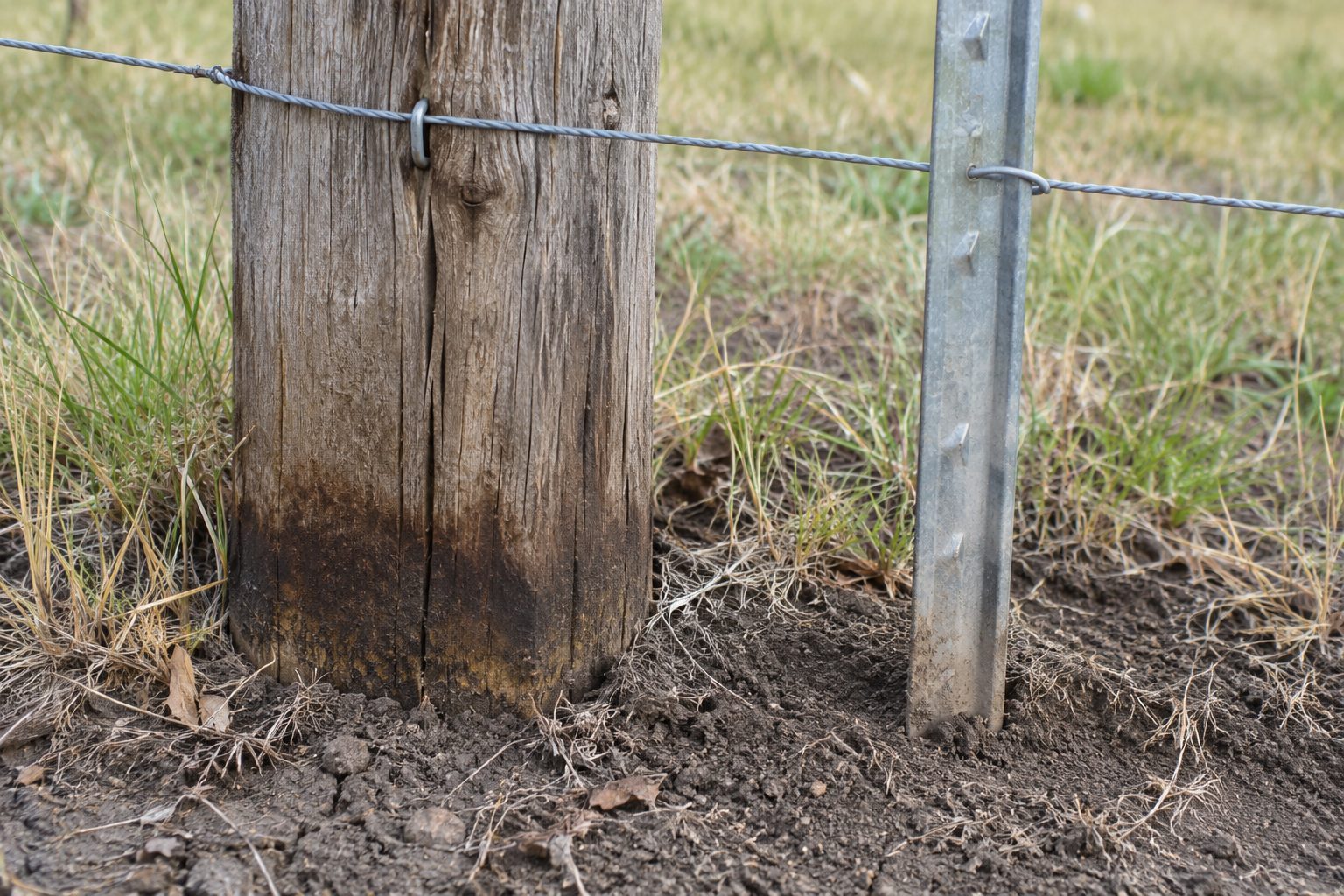
One supplier's table of species
One commercial timber supplier's brochure goes a step further and names species. It is a brochure, not a standard, and it is a secondary source. Its table is simplified. It relates to heartwood only, not sapwood, and it assumes careful detailing and regular maintenance. Read with those limits, it lists the following.
| Species in the brochure | Durability class | In-ground life shown (years) |
|---|---|---|
| Forest red gum | Class 1 | 25 or more |
| Grey ironbark | Class 1 | 25 or more |
| Cypress | Class 1 | 25 or more |
| River red gum | Class 2 | 15 to 25 |
The brochure's table shows class 1 with an in-ground life of 25 or more years and class 2 with 15 to 25 years. Those figures belong to the brochure and to heartwood in good conditions. They do not describe a fence built on your land. The brochure does not name white cypress, cypress pine, grey box or yellow box, so we say nothing about them.
Hardwood and cypress posts are rated for in-ground durability. Ask the contractor which species and which class they supply, and ask for it in the quote. We do not call any species local to NSW, a best post or resistant to any particular pest, because no source we read says so.
What the sources do not say
The gaps matter as much as the figures, so here they are in one place. For each item below, the contractor's specification is where the answer should be.
| Question | What we found | What to do |
|---|---|---|
| How long fence wire lasts | No source we trust gives a figure. | Ask what wire grade is quoted and what the contractor says about its life |
| Corrosion rates in Riverina conditions | None found. | Ask what coating or galvanising the wire carries |
| Galvanising class or coating thickness | None found. The wire maker's own coating claim is the maker's. | Ask for the coating spec in writing |
| How long gates and strainer assemblies last | None found. | Ask what they are built from and how they are braced |
| Effects of cold weather on posts and wire | None found. | Ask whether the contractor has seen any on similar land |
The hinge joint data sheet we read makes a claim about its own wire coating. That claim is the manufacturer's, and we do not repeat it as fact. It also gives no post spacing, no strainer spacing and no figure for the life of the fence.
What shortens a fence's life, from the sources
Several causes are sourced. Flood water and debris are the first. Victorian Government guidance for riparian fences in flood-prone areas, an interstate source, says no fence can be designed to withstand a major flood, and notes that plain wire is easier to clean up and re-strain than mesh or barbed wire (the guidance). The flood and fire damaged fence repair page goes further.
Timber below its needed durability class is the second. A post rated lower than the job needs may fail sooner. Coating quality is the third, but the only source is the manufacturer's own claim. The fourth is electric fence faults. The same flood guidance says electric fences need reliable power and regular checks for shorts.
Questions to put to a contractor
- Which post species or treatment class is quoted, and is it named in writing?
- Are the posts heartwood, and how is that checked on delivery?
- What wire grade and coating does the quote assume?
- How will the strainer assemblies be built on my soil?
- What happens to the fence in a flood, and what is easiest to repair?
- For an electric fence, what needs checking and how often?
Fence type and materials also move the price, so read the cost factors guide alongside this page. The sheep and cattle fencing page covers wire grades, and you can send your fence details when you are ready.
What this guide cannot do
This guide cannot tell you how many seasons your fence will stand. Life depends on the post, the wire, the ground, the weather, floods and how the fence is built and kept, and the sources we read cover only part of that. The timber figures come from one education body and one commercial brochure, and neither is a standard or a promise.
We are a referral service. Your enquiry is passed to a local contractor, who sets their own specification and terms, and we do not quote, build or sign contracts. Ask the contractor what they will build and why.
Check the current rules before you rely on this
This page describes what the sources say about post timber ratings and what shortens the life of a rural fence. It describes the rules in general terms as they stood in November 2026. Standards, forms, thresholds and fines change.
The authoritative sources are Australian timber industry education body, fencing (durability classes and treatment), Timber supplier brochure, natural durability of timber by class (commercial brochure, not a standard; secondary), One manufacturer's hinge joint livestock fence data sheet (manufacturer claims are the manufacturer's) and Victorian Government, guidelines for riparian fencing in flood-prone areas (2015; Victorian guidance, interstate). Where anything here differs from those sources, they are right and we are not.
We are not fencing contractors, builders, regulators or lawyers. For what applies to your fence, ask the contractor which licence or registration they hold for your job, then ask NSW Fair Trading or Building Commission NSW if you are unsure, and ask the council that covers the land.
Accurate at the time of writing, November 2026. Always check the source before relying on it.